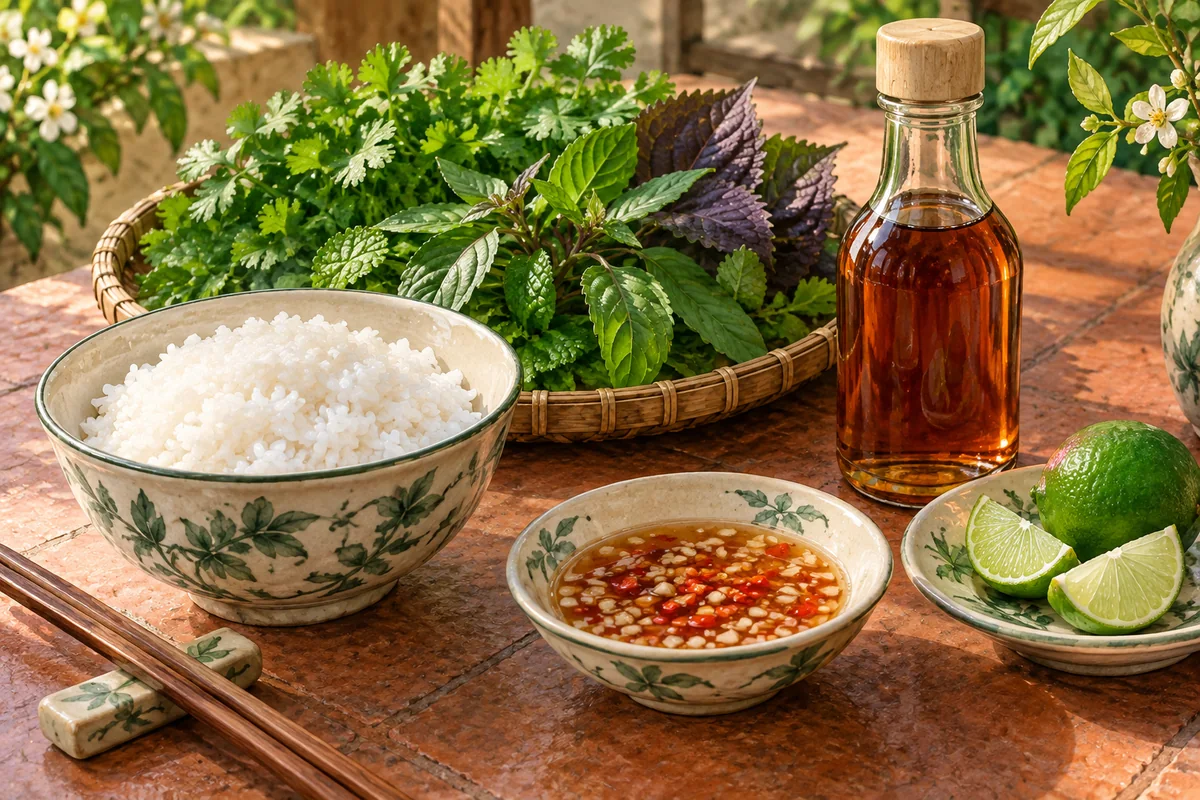
Three ingredients do an enormous amount of work in Vietnamese cooking.
Rice (cơm) is so central that "eating rice" simply means "eating a meal." Rice also becomes noodles (phở, bún, bánh phở, hủ tiếu), paper (bánh tráng), flour for crêpes and cakes, porridge (cháo), wine, and vinegar. The Red River and Mekong deltas made Vietnam one of the world's great rice-growing regions, and rice has been tied to labor, taxation, famine, and survival throughout Vietnamese history.
Fresh herbs (rau thơm) are treated as an ingredient, not a garnish. A plate of herbs on the table — Thai basil, cilantro, perilla, fish mint, rice paddy herb, sawtooth coriander, mint — lets each person tune their own bowl. This is one reason Vietnamese food often tastes bright rather than heavy.
Fish sauce (nước mắm) is anchovy and salt, fermented for months. On its own it is intensely savory; mixed with lime, sugar, water, garlic and chili it becomes nước chấm, the dipping sauce that shows up at countless meals. Regions and families argue about the ratio, and many people can tell whose recipe they're eating.
Learn these three and a surprising amount of the cuisine starts to make sense.