
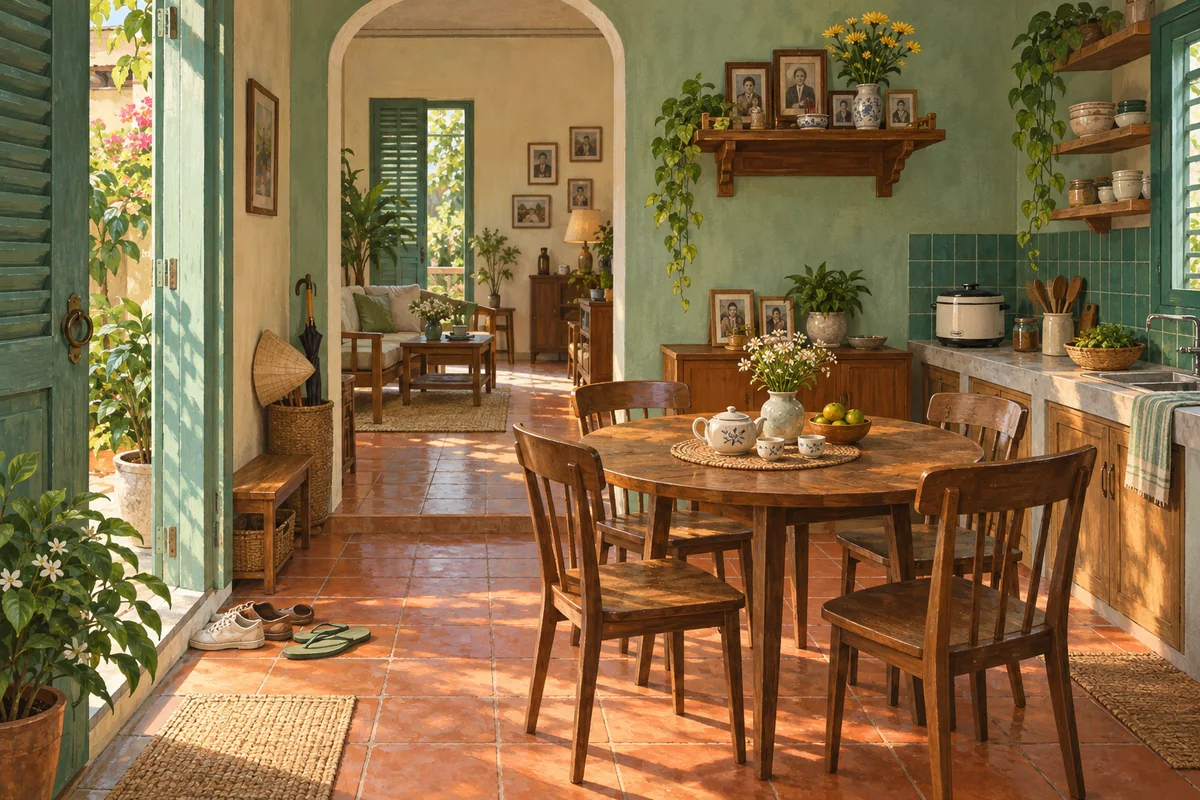
Partly practical and partly conceptual: shoes track in dirt from streets and fields, and the home is treated as a clean, separate space — especially in households where people sit or eat on the floor, and where an altar makes the home a place of respect.
Removing shoes indoors is common across much of Asia and is standard in most Vietnamese households. Guests are typically expected to leave shoes at the entryway; many homes keep a rack and a basket of house slippers for visitors.
The practical origin is straightforward — unpaved roads, rice fields, monsoon mud, and long histories of living close to the ground. But it also carries a boundary meaning: outside is public and dirty, inside is family and clean. Bringing the outside in is the thing being avoided.
In homes with an ancestral altar, that boundary has an additional layer of respect attached to it.
If you are visiting, the simplest approach is to pause at the door and look. If there are shoes lined up, take yours off. If the host insists you keep them on, believe them — some households, especially in cold climates or with renovated floors, genuinely don't mind.
Very widely practiced, though not universal — and rules loosen in some households abroad, at parties, or for guests who are only stepping in briefly.