Vietnamese family titles communicate generation, relative age, and family side — which is why the language has so many words English translates as “aunt” or “uncle.”
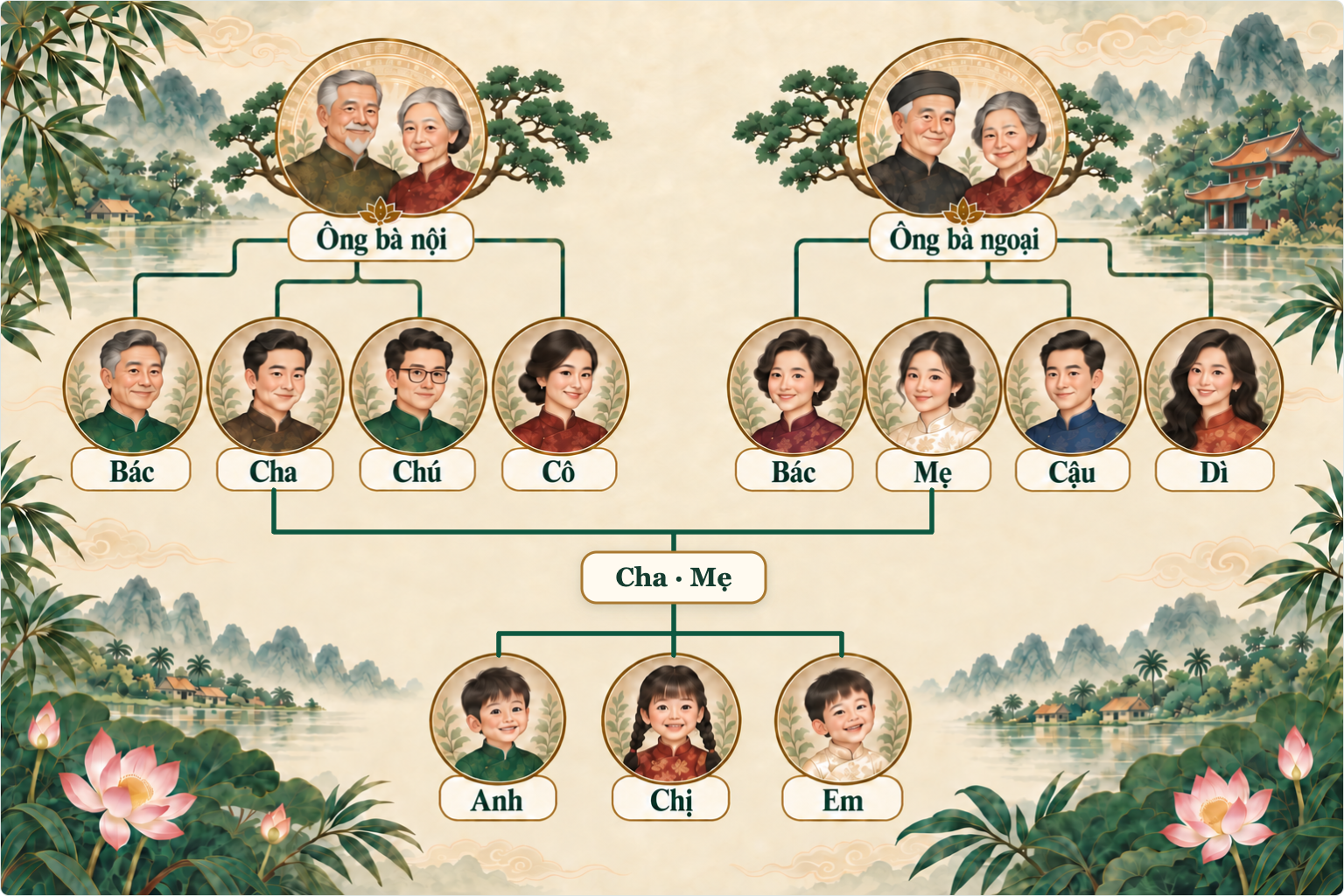
An imagined contemporary family reunion; kinship language depends on relationships and family usage.
Vietnamese speakers often address someone using a family term that fits their relationship, and refer to themselves with a corresponding term. Other pronouns are used too; formality and context shape the choice. Speaking to an older woman roughly your age, you become em and she becomes chị. Speaking to a child, you might be cô or chú and they become con or cháu.
These titles encode several things at once:
Generation — grandparent, parent, sibling, child
Relative age — older or younger than your parent, older or younger than you
Side of the family — mother's side or father's side
Sometimes marriage — whether someone married in
So dì (your mother's sister) and cô (traditionally your father's sister) are not interchangeable words for "aunt." They carry information that English drops.
This also extends outside the family. Strangers are addressed with the title that would fit if they were family: a young man is anh, a woman around your mother's age is cô or dì, an older man is chú or bác. It is not pretending to be related. It is a way of placing someone respectfully in relation to yourself.
Usage varies by region and by family. Southern and northern families sometimes use bác, cô, and dì differently, and plenty of families simply have their own habits. If you are unsure, listening to what your relatives call each other is the most reliable guide there is.
A visual family map
One connected family tree
Dad’s relatives are on the left, Mom’s are on the right, and their children connect below. For aunts and uncles, older/younger is compared with Cha or Mẹ; for Anh, Chị, and Em, it is compared with you.
Swipe across the illustration to follow both sides of the family →
FATHER’S SIDE · BÊN NỘI
Ông nội · Bà nội Your father’s parents — your paternal grandparents.
BácYour father’s older brother or older sister.
ChaYour father.
ChúYour father’s younger brother.
CôYour father’s younger sister.
MOTHER’S SIDE · BÊN NGOẠI
Ông ngoại · Bà ngoại Your mother’s parents — your maternal grandparents.
BácYour mother’s older brother or older sister.
MẹYour mother.
CậuYour mother’s younger brother.
DìYour mother’s younger sister.
IMMEDIATE FAMILY · GIA ĐÌNH
Cha · Mẹ Your father and mother — your parents.
AnhYour older brother.
ChịYour older sister.
EmYour younger brother or younger sister.
REGIONAL & FAMILY USAGE This chart teaches common Northern Vietnamese family terms from the child’s perspective. For aunts and uncles, “older” or “younger” means older or younger than your father or mother — not older or younger than you. Terms can vary by region and family, especially for relatives by marriage. Follow the terms your family uses.
Practices vary across regions, communities, generations, and individual families. This guide offers starting points for learning and conversation.